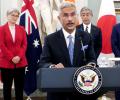
If the only superpower, which calls India an ally, sees the region through an India-Pakistan prism, it is unacceptable. Rather than endorse India's sphere of influence, this undermines it, asserts Shekhar Gupta.

'The protection of secrecy and anonymity gets lost with this linking.'
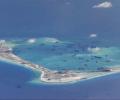
China will prioritise the development of a floating nuclear power platform in the coming five years.

Bhutto, who served as the Foreign Minister earlier, addressed a briefing at the UN Headquarters in New York and sought reconciliation with India, making a plea for talks and Intel sharing between the two neighbours.

There is a secured system to tackle cyber attacks and there is a segregation of nuclear generation from the administrative segment, There is a secured system to tackle cyber attacks and there is a segregation of nuclear generation from the administrative segment, he said.

Defence Minister Rajnath Singh stated India's readiness to assist Pakistan in combating terrorism if it cannot act on its own, highlighting Operation Sindoor as a demonstration of India's capabilities. He also criticized Pakistan's appointment to a UN counter-terrorism committee.
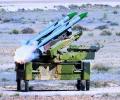
'When one air force (India's) hits the other's airbases with impunity and that air force (Pakistan's) is not able to respond, then the air force, which has put the other's airbases out of commission, has won.'

Terming Pakistan as a 'failed state', National Conference (NC) president Farooq Abdullah Thursday said relations between New Delhi and Islamabad would never improve until a peoples' government is elected in the neighbouring country.

A major escalation unfolded in West Asia on Monday after Iran reportedly launched multiple missiles targeting United States military installations in Qatar and Iraq, including Al Udeid Air Base in Qatar -- the largest US military installation in the region, according to a CNN report.

US Vice President JD Vance called on India to drop non-tariff barriers, give greater access to its markets and buy more American energy products and military hardware. Vance, in a speech in Jaipur, highlighted the need for a stronger US-India partnership for a prosperous and peaceful 21st century. He emphasized the importance of working together to address global challenges and praised Prime Minister Narendra Modi, describing him as a "special person." Vance also urged India to provide greater market access to American products and buy more defense platforms and energy from the US. He suggested that India consider dropping some of the non-tariff barriers for American access to the Indian market and highlighted the benefits of closer India-US defense collaboration, advocating for New Delhi to procure more military hardware from the US. He cited the example of American fifth-generation F-35s, arguing they would give the Indian Air Force the ability to defend its airspace and protect its people like never before. Vance also welcomed the Modi government's budget announcement to amend India's civil nuclear liability laws, paving the way for US producers to export small modular reactors and build larger US-designed reactors in India. He emphasized the importance of energy security for India's AI ambitions, stating "there is no AI future without energy security and energy dominance." Vance's visit comes amid growing global concerns over the US's tariff war.
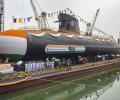
The status of the current submarine force level is alarming and we need to address the threat perceptions expeditiously. Critical decisions pertaining to national security cannot be delayed any further due to the rapidly changing maritime threat perceptions and growing strategic importance of the Indian Ocean region, asserts Commodore Venugopal Menon (retd).

'What the Americans want is to destabilise Iran. For destabilising Iran, you need access. 'One access is through Iraq. The other access is through Pakistan.'

'A man who brought about the greatest set of economic reforms in the country, who changed the course of Indian history, cannot be considered weak.' 'A man who fought for nuclear reforms even though his majority in Parliament was threatened, he cannot be considered weak.'

'The touchstone is reciprocity which will be applied to friends and foes alike.' 'It will be a bitter pill to swallow.'

Trump has a major decision to take in coming days -- specifically, how to rescue Israel from the attritional war that lies ahead, points out Ambassador M K Bhadrakumar.

Trump couldn't care less anymore about the Israeli demand for Iran's 'de-nuclearisation' and 'de-militarisation.' Trump pins hopes on a grand bargain with Iran as a partner in America First, argues Ambassador M K Bhadrakumar.

US President Donald Trump has repeated his claim that Washington got involved with India and Pakistan, saying he didn't like what was happening and that he did a good job as he convinced the two countries to let's have peace and let's go and make trade deals.

A new book reveals that India and Pakistan discussed a communal division of Jammu & Kashmir along the Chenab river before the Kargil war in 1999.

Many were hoping that with Vajpayee's NDA gone, there would be a return to the Congress normal. Nobody was prepared for the opposite. Sonia Gandhi was sceptical. This became the only issue over which Manmohan Singh took on his party bosses and risked his government. Politically, it was riskier than the 1991 reform, recalls Shekhar Gupta.

On board the INS Vikrant, the supreme commander of India's defence services witnessed several naval operations including a MiG 29K take-off and landing, missile firing drills from warship and submarine operations.
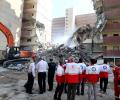
The IDF said that all of its bases, including air bases, are operating as usual with no harm to their functionality.

Trump has played throughout his career as a deal-maker who could deliver where others could not, and Ukraine represents the ultimate test of that image, notes Manish Dabhade.

Today nearly 440 nuclear reactors produce electricity around the world. More than 15 countries rely on nuclear power for 25 per cent or more of their electricity. In Europe and Japan, the nuclear share of electricity is over 30 per cent. In the US, nuclear power creates 20 per cent of electricity.
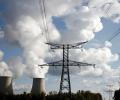
India is working on new technologies such as the small modular reactors that can be factory-built and help make clean energy transition, Science and Technology Minister Jitendra Singh said in New Delhi.
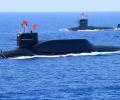
China has delivered a second advanced submarine to Pakistan, part of a larger deal to bolster the South Asian nation's naval capabilities in the Indian Ocean. The move underscores China's growing influence in the region and its strategic partnership with Pakistan.

Chief of Defence Staff General Anil Chauhan emphasized the need for constant high military preparedness, citing Operation Sindoor as an ongoing example. He also highlighted the importance of 'information warriors, technology warriors and scholar warriors' in future warfare.
Plans to build India's biggest indigenous nuclear power plant have failed to impress villagers in Haryana's Fatehabad district, who fear a Fukushima-type disaster. The shoddy way in which the government agencies have handled the issue has not helped matters either. Gopal Krishna reports.

In a year bookended by intractable conflicts and geopolitical fragmentation, India focused on ramping up military prowess by broadly firming up defence procurement worth Rs 4.22 lakh crore even as Indian and Chinese militaries completed pulling back their troops from border face-off points in eastern Ladakh.

'We should watch -- in the near term -- for signs that the two have totally fallen out at a personal, political level.' 'Trump and Modi know how to be dealmakers, but they also know how to hold a grudge.'
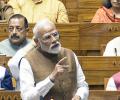
What was the aim of Operation Sindoor? Why was the operation halted so soon? asks Lieutenant General Prakash Katoch (retd).

In a show of strength, China is deploying its aircraft carrier group and a nuclear submarine in large-scale military drills in the Taiwan Strait in response to US House Speaker Nancy Pelosi's high-stakes visit to Taipei which infuriated Beijing as it claims the island as part of its territory.
Rediff.com's A Ganesh Nadar hopped on to a fishing boat at Kudankulam amid the anti-nuclear power protests at sea.

If the US' renewed closeness with Pakistan ends up strengthening Pakistan's military, it will clearly show that Washington no longer wants a strong India and could be ready to let China dominate Asia, notes Colonel Anil A Athale (retd).
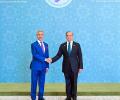
It was said that Sharif wanted the PML-N-led coalition government to utilise all available diplomatic resources to restore peace between the two nuclear-armed states, saying he was not keen on taking an aggressive position, The Express Tribune reported.

China and Pakistan are in a tight strategic alliance. India must deal with them one at a time, but be prepared in case they decide to collude, points out Shekhar Gupta.

"No country besides Russia has ever fired upon an atomic power plant's reactors. The first time, the first time in history," he said, urging European leaders to 'wake up now' and stop Russian forces 'before this becomes a nuclear disaster'.
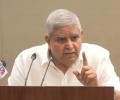
Rajya Sabha member Kapil Sibal has criticised Vice President Jagdeep Dhankhar for questioning the judiciary over the timeline for the president to take decisions, calling it "unconstitutional " and a lowering of the dignity of the chair. Sibal asserted that Dhankhar's remarks are not neutral and amount to an attack on the judiciary by the executive. He also pointed out that the president acts on the aid and advice of the council of ministers, and therefore, the president's power cannot be curtailed. Sibal urged Dhankhar to seek a review of the judiciary's decision or an advisory opinion from the Supreme Court if he has problems with it. He also questioned why Dhankhar only focuses on actions taken during Congress governments and not after 2014.

Veteran atomic scientist and former chairman of Atomic Energy Commission Dr Sekhar Basu succumbed to Covid-19 early on Thursday at a private hospital in Koklata, a health department official said. He breathed his last just three days after turning 68.

India has to fill in all the critical gaps in missiles, ammunition, sensors and stockpile in the fastest possible manner, focusing on the critical instruments that worked this time, asserts Shekhar Gupta.
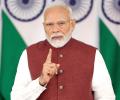
'Three days after the Kargil War ended, the Vajpayee Government set up the Kargil Review Committee on July 29 1999. Its report was tabled in Parliament on February 23, 2000 although sections of it have remained classified -- as indeed they must'
